Turnkey vs Traditional Office Setup: Which One Delivers Better Results?
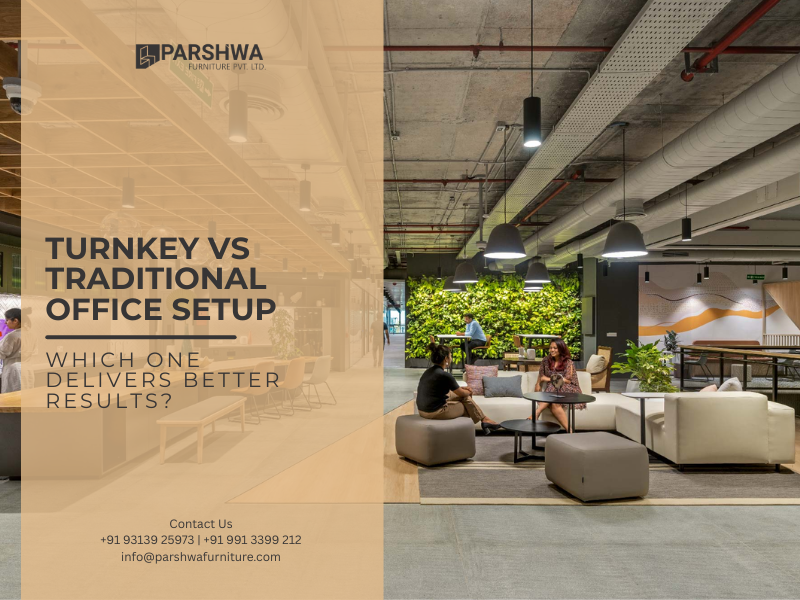
Turnkey vs Traditional Office Setup: Which One Delivers Better Results?
For large corporations, multinational companies, and enterprise-scale organizations, an office is far more than a functional space. It represents brand identity, operational discipline, workplace culture, and long-term strategic intent. Every design decision, furniture choice, and execution detail has a direct impact on employee performance, leadership perception, and client confidence.
When a large office or workspace is designed, always take care of each and every aspect of designing, branding, furniture quality & ideal space management. There are always been a decision makers are often faced with a fundamental choice: Should the office be executed through a turnkey model or a transition setup? And that the decision makes workspace more workable in structure, elegant in looks and functional in process, and that's become ever more critical for organisations investing in office furniture turnkey projects, particularly those evaluating an office furniture turnkey project in Ahmedabad or expanding through an office furniture turnkey project in India.
This article takes a practical, experience-led approach to help large enterprises understand which model delivers measurable business value, operational clarity, and long-term reliability.
Understanding the Traditional Office Setup Model
How Traditional Office Execution Typically Works
In a traditional office setup, responsibilities and assembling are divided among multiple independent stakeholders. Architects or interior designers develop the layout and concept. Furniture vendors are selected conveniently. Civil contractors to structure changes, electrical team to power supplies, IT Integrators, HVAC Consultatnt and project supervisors operate under separate scopes of work. That might result in mismanagement sometimes and a cluttered process with delayed timelines of office interior projects.
For large organisations, this often means the internal facilities, procurement, or project management teams become the central coordinating authority. While this model offers vendor-level flexibility, it introduces significant operational complexity.
Each Stakeholder works within their own timelines and priorities. Even with strong contracts and planning, misalignment between design intent and execution is commo,n but particularly in
Challenges Faced by Large Corporations in Traditional Setups
For enterprise-scale offices, traditional execution can become increasingly difficult to manage. Decision-making cycles are longer, approvals involve multiple departments, and any delay multiplies across floors or locations. When furniture does not align perfectly with layouts or services are installed without full context, rework becomes expensive and disruptive.
For enterprises interior, traditional execution can become a blunder and too scattered to manage. The decision-making cycle will be longer, approvals involves and execution involves multiple department and any delay multiplies across the whole project.
A more important part of the interior project, accountability, becomes fragmented. When something goes wrong, resolution often requires coordination with multiple vendors, slow down progress and follow ups then it will increases management overhead.
What a Turnkey Office Setup Means for Enterprises
A Single, Integrated Delivery Model
A turnkey office setup brings design, execution, furniture manufacturing, installation, and project management under one accountable partner. From the first phase of planning and discussion to the final handover, the entire office is delivered as the fines solutions.
In office furniture turnkey projects, furniture is not treated as an afterthought. It is engineered alongside layouts, workflows, technology integration, and brand guidelines. This ensures that every workstation, collaboration zone, leadership cabin, and support area functions exactly as intended.
In the Office Furniture Turnkey Projects, furniture is not treated like an afterthought. It is specially engineered alongside layouts, workflows, technological integration, space management, air and light speculation and brand guidelines. This ensures that every workstation, collaboration zone, leadership cabin, and support area function exactly as mean to be.
For large organizations operating across multiple cities or regions, this integrated approach significantly reduces complexity and improves consistency.
Why Turnkey Execution Is Gaining Enterprise Trust
Large corporations smartly choose turnkey execution because it mirrors how they operate internally: clear ownership, defined outputs, and accountability. Instead of managing all the different vendors, leadership engages with one responsible partner who understands the broader business context.
This shift is particularly visible in office furniture turnkey projects in India, where speed, dedication, minimal communication and standardisation have become essential for corporate growth.
Accountability at Scale: The Enterprise Advantage of Turnkey Models
Single-Point Responsibility vs Distributed Ownership
In traditional setups, accountability is divided. Designers, contractors, and vendors operate independently, making it difficult to assign responsibility when issues arise. For large offices, this often results in prolonged resolution cycles.
Turnkey execution eliminates this risk. One partner owns the entire outcome, from design accuracy to furniture quality and installation timelines. If a challenge occurs, it is addressed internally rather than passed between vendors.
For MNCs and large corporations, this clarity of ownership aligns with enterprise governance standards and risk management expectations.
Time Efficiency and Predictable Delivery Timelines
Why Time-to-Occupancy Matters for Large Offices
Delays in office readiness can have substantial financial and operational consequences. Extended leases, delayed team onboarding, and postponed project launches directly affect revenue and productivity.
Traditional office setups often follow a linear execution model. Design approval must be completed before procurement begins. Furniture production waits for site readiness. Each dependency introduces idle time.
Turnkey office execution follows a parallel planning approach. Furniture manufacturing, site execution, and service coordination progress simultaneously. Because dependencies are managed internally, timelines remain predictable.
This efficiency is a major reason enterprises planning an office furniture turnkey project in Ahmedabad increasingly opt for turnkey delivery.
Cost Control and Budget Confidence for Corporations
Financial Transparency in Turnkey Projects
Large organizations require financial predictability. Budget overruns, scope creep, and unplanned expenses can disrupt capital planning and internal approvals.
Traditional setups often struggle with cost visibility because each vendor operates under separate contracts. Changes in one area frequently impact others, leading to cumulative cost increases.
Turnkey projects operate on a consolidated commercial framework. Costs are defined upfront, covering design, execution, and furniture. This structure provides leadership with clear financial visibility and reduces approval friction.
Over the full lifecycle of the project, turnkey execution often proves more economical by minimizing rework, reducing downtime, and eliminating coordination inefficiencies.
Design Integrity and Brand Consistency
Why Design Alignment Matters at Enterprise Scale
For large offices, design consistency is not just aesthetic. It influences brand perception, employee experience, and leadership culture. In traditional setups, design intent can weaken during execution due to fragmented responsibility.
Furniture selections may not fully align with layouts. Lighting and acoustics may be compromised. The final outcome often differs from the original vision.
Turnkey execution preserves design integrity. Space planning, furniture engineering, lighting strategy, and service integration are developed as one cohesive system. This results in offices that reflect corporate identity while supporting real-world functionality.
Furniture Integration as a Strategic Asset
Beyond Products: Furniture as Infrastructure
In enterprise environments, furniture must support long working hours, diverse teams, collaboration, and technology integration. Poorly planned furniture impacts productivity and increases long-term maintenance costs.
In office furniture turnkey projects, furniture is designed and deployed as part of the overall infrastructure. Workstations align with power and data layouts. Storage integrates seamlessly with circulation paths. Leadership spaces reflect hierarchy without compromising comfort.
This approach is particularly valuable for organizations scaling across office furniture turnkey projects in India, where consistency across locations matters.
Quality Assurance and Long-Term Durability
Managing Quality Across Large Office Footprints
Large offices involve extensive square footage and high daily usage. In traditional models, maintaining consistent quality across multiple vendors is challenging.
Turnkey execution introduces centralized quality control. Materials, finishes, furniture specifications, and installation standards are uniform throughout the project. This consistency enhances durability and reduces long-term maintenance costs.
For corporations focused on asset longevity and operational efficiency, this reliability is a significant advantage.
Scalability, Flexibility, and Future Expansion
Designing for Growth and Change
Large organizations rarely remain static. Teams expand, departments evolve, and work models shift. Offices must be designed to accommodate this change.
Traditional setups often lack modular planning, making future reconfiguration expensive and disruptive.
Turnkey office solutions are built with scalability in mind. Modular furniture systems, flexible layouts, and adaptable infrastructure allow offices to evolve without major downtime. This future-ready approach aligns well with enterprise growth strategies.
Compliance, Safety, and Corporate Risk Management
Reducing Regulatory and Operational Risk
Compliance with safety regulations, fire norms, electrical standards, and accessibility guidelines is critical for large offices. In traditional setups, responsibility is distributed, increasing the risk of oversight.
Turnkey partners manage compliance holistically. Design, execution, and approvals are aligned with applicable regulations, reducing exposure to legal or operational risk.
For large corporations, this integrated compliance management supports corporate governance standards.
Leadership Focus and Management Efficiency
Preserving Executive Bandwidth
One of the most overlooked costs in traditional office execution is leadership time. Continuous coordination, decision-making, and conflict resolution demand significant management attention.
Turnkey execution simplifies engagement. Leadership teams review milestones rather than manage daily execution. This allows executives to focus on strategic priorities rather than operational firefighting.
For large organizations, this efficiency has tangible value.
When Traditional Office Setup May Still Be Considered
Traditional office execution may still be suitable for niche scenarios, such as highly experimental design environments or projects managed entirely by in-house teams with deep technical expertise.
However, for large offices with complex requirements, the risks associated with fragmented execution often outweigh the perceived flexibility.
Why Turnkey Office Execution Aligns with Enterprise Needs
The growing adoption of turnkey office execution reflects a broader shift in how enterprises approach infrastructure investments. Predictability, accountability, and integrated delivery now matter more than fragmented control.
As demand for office furniture turnkey projects continues to rise, organizations seek partners who can deliver complete, ready-to-operate workspaces without operational friction. In Ahmedabad and across India, turnkey execution has become the preferred model for large-scale corporate offices.
Parshwa Furniture has seen this transformation firsthand, supporting enterprises that prioritize performance-driven, future-ready workplaces.
Choosing the Right Office Execution Strategy
For large corporations and MNCs, the choice between turnkey and traditional office setup is not merely a design decision. It is a strategic investment decision.
If your priorities include delivery certainty, financial control, design integrity, scalability, and reduced management burden, turnkey execution consistently delivers superior outcomes. Traditional setups may offer selective flexibility, but they demand higher involvement and carry greater risk at scale.
For enterprises planning their next workspace—whether through an office furniture turnkey project in Ahmedabad or broader office furniture turnkey projects in India—the most effective approach is one that aligns office execution with long-term business vision, operational discipline, and organisational growth.