Corporate Interior Design Trends That Improve Work Efficiency
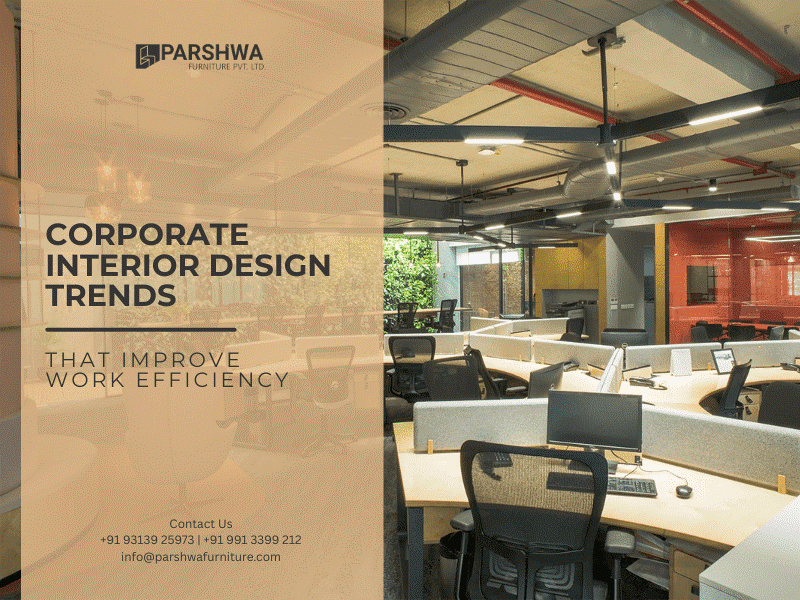
Offices That Work, Not Just Look Good
There was a phase when corporate interiors were built to impress. Clean lines, glossy finishes, and open layouts became the standard. But over time, many of those spaces revealed a problem-they looked efficient but didn't feel efficient.
People struggled to focus. Conversations spilled into work zones. Movement across the office felt unnecessarily long.
Today, businesses are asking a different set of questions. Instead of focusing on appearance, they are looking at how smoothly a workday flows inside the space. Where do interruptions happen? Where do delays build up? What causes fatigue?
Modern corporate interior solutions are built around these observations. The goal is simple-remove friction wherever possible. When the environment supports the workflow, productivity doesn't need to be forced.
Designing for How People Actually Work
No two employees work in exactly the same way, but there are patterns. People need moments of deep focus, periods of collaboration, and occasional breaks to reset. A well-designed office quietly supports all three.
This is where human-centric design becomes practical rather than conceptual.
Ergonomics is often the starting point, but it's not just about adding better chairs. It's about how long someone can sit without discomfort, how easily they can switch posture, and whether their workspace supports sustained attention.
In many office furniture turnkey projects in Ahmedabad, businesses are now prioritizing these details because the impact is visible. Employees stay engaged longer. Small physical irritations-something as simple as poor seating-stop interrupting the workday.
Over time, these small improvements compound into measurable gains.
Flexibility That Matches Modern Work Patterns
Workplaces are no longer predictable. Some days are collaboration-heavy, others require uninterrupted focus. Hybrid models have only made this more dynamic.
Rigid layouts struggle in this kind of environment.
That's why flexibility has moved from being a "nice feature" to a necessity. Offices are now designed to shift-sometimes within the same day. A space that supports individual work in the morning can transform into a discussion area later.
This adaptability is often built into office furniture turnkey projects, where modular elements are planned in advance rather than added later. The result is a workspace that evolves without constant redesign.
From an employee's perspective, this makes a noticeable difference. Instead of adjusting to the space, they can choose a setup that fits their task. That choice alone improves both comfort and output.
The Quiet Importance of Focus Zones
Open offices changed the way teams interact, but they also introduced a constant background of noise. Over time, this has pushed companies to rethink how space is divided.
Instead of going back to closed layouts, the approach has become more nuanced.
Workspaces are now layered. Some areas naturally encourage conversation, while others discourage it without needing rules or signs. This balance isn't always obvious when you walk in-but you feel it when you work there.
Acoustic design plays a larger role than most people realize. Materials, spacing, and even ceiling structures are used to absorb or redirect sound. In well-executed office furniture turnkey projects in India, this is planned early, not corrected later.
When distractions reduce, focus improves. It's a simple equation, but one that depends heavily on design.
Technology That Doesn't Get in the Way
There was a time when adding more technology meant adding more complexity. Today, the expectation is the opposite.
The best workplaces are the ones where technology blends in. You don't notice it-you just benefit from it.
Meeting rooms start without setup delays. Devices connect without effort. Lighting adjusts without manual control. These aren't dramatic changes, but they remove small interruptions that otherwise repeat throughout the day.
Over time, those interruptions matter.
Companies adopting advanced corporate interior solutions are increasingly looking at how to reduce these friction points. The focus is not on adding features, but on simplifying everyday tasks.
A Subtle Shift Towards Natural Elements
There's a reason people feel more comfortable working near a window or in a space with some greenery. It's not just preference-it's response.
Natural light, softer materials, and organic textures create a different kind of work environment. One that feels less draining.
Biophilic design has gained attention, but in practice, it's less about trends and more about balance. Too much artificial lighting, too many hard surfaces-it adds up over time.
Modern offices are slowly correcting this. Plants are being integrated, layouts are adjusted to allow more daylight, and materials are chosen to soften the overall feel of the space.
These changes don't shout for attention, but they do change how people experience the workday.
Simplicity That Improves Clarity
There's a noticeable difference between a space that looks minimal and one that functions simply. The latter is harder to achieve.
In many offices, clutter isn't just visual-it's operational. Extra furniture, poorly planned storage, and confusing layouts slow people down in ways that aren't immediately obvious.
Simplified design removes these obstacles.
In office furniture turnkey projects in Ahmedabad, there's a growing focus on doing more with less-less clutter, fewer unnecessary elements, and clearer movement paths. Storage is built in, not added later. Furniture serves more than one purpose.
When everything has a place and a function, work becomes smoother. People spend less time adjusting their environment and more time focusing on their tasks.
When the Office Reflects the Company
An office doesn't need to explain a company's culture-but it often reveals it.
The way space is used, the materials chosen, even the layout of workstations-it all sends signals. Employees pick up on these signals, often without realizing it.
When the environment feels aligned with the organization's values, it creates a sense of consistency. That consistency builds trust, and over time, engagement.
Well-executed office furniture turnkey projects in India take this into account. Branding isn't applied on top-it's built into the design.
Sustainability That Feels Practical
Sustainability has moved beyond being a talking point. In many cases, it's simply good business.
Better lighting reduces energy costs. Improved ventilation creates a healthier workspace. Safer materials contribute to long-term well-being.
These changes don't always stand out individually, but together they improve how the office functions.
Modern corporate interior solutions are integrating these practices in a way that feels practical rather than forced. The focus is on creating environments that are efficient, responsible, and comfortable to work in.
Why Turnkey Execution Makes a Difference
Designing an office involves more moving parts than it appears. Layout planning, furniture selection, execution, finishing-each stage depends on the other.
When handled separately, gaps tend to appear.
Turnkey solutions bring these elements together under a single approach. The advantage is not just coordination-it's consistency. What gets planned is what gets delivered.
Businesses opting for office furniture turnkey projects often find the process smoother and more predictable. Timelines improve, and compromises reduce.
In cities with growing commercial demand, office furniture turnkey projects in Ahmedabad are increasingly becoming the preferred route for companies that want clarity from start to finish.
Where Efficiency Actually Comes From
Most productive offices don't look extraordinary. They just work.
People don't spend time adjusting chairs, searching for quiet spaces, or dealing with constant interruptions. They move through the day without friction.
That's what good design does-it disappears into the background.
Organizations investing in thoughtful corporate interior solutions are not just upgrading their spaces. They're improving how work happens every day, often in ways that aren't immediately visible but are consistently felt.
And that's where real efficiency begins.