Common Mistakes Companies Make While Choosing Office Furniture Turnkey Solutions
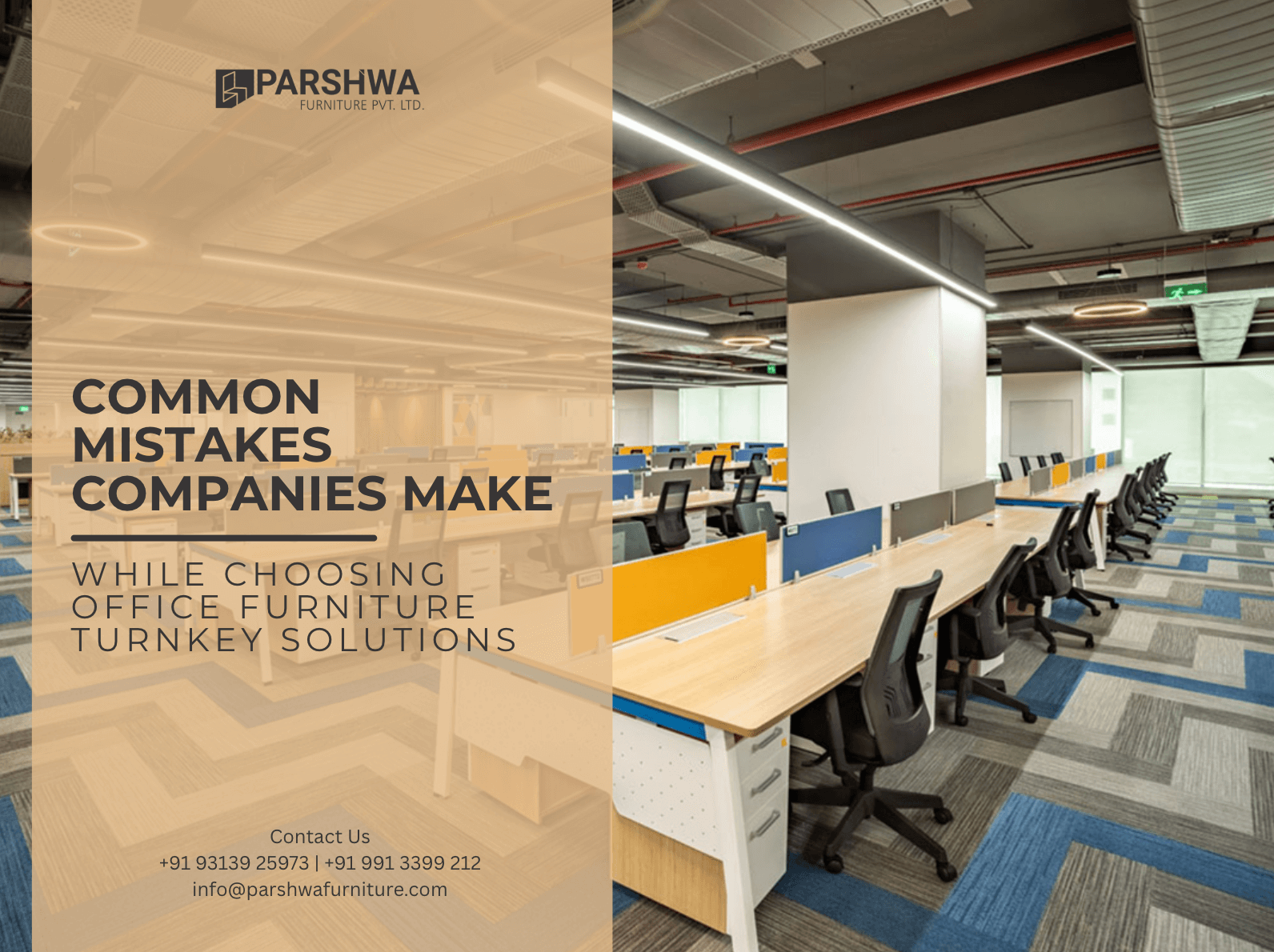
Common Mistakes Companies Make While Choosing Office Furniture Turnkey Solutions
Introduction
Office furniture decisions are often treated as operational tasks—something that needs to be completed quickly so work can begin. In reality, the number of decisions you make shapes people's function in a space's everyday operations. From productivity and comfort to brand Psychology and long term maintenance cost, and many more, the impact of office Furniture extends far beyond aesthetics.
This is why many organisations now opt for Office Furniture Turnkey Projects, expecting a smoother process and a single point of responsibility. When the approach itself is sound, problem rises when you companies rush to select their turnkey partner or make decisions based on incomplete evaluation.
Across a number of industries like IT companies, Finance selectors, Construction Groups, or any Large team of corporate offices, even an interior design firm, the same mistakes appear repeatedly. Poor structural & design planning, misplaced priorities, and lack of technical understanding often lead to offices that look acceptable on day one but become problematic on the day after possession. Here we can discuss how to avoid those mistakes and how Parshwa Furniture, as the Office furniture turnkey project doer, can help your space design smartly and look will be modernised as per you requirements.
What Turnkey Office Furniture Really Means in Practice
Turnkey office furniture solutions are not just about supplying desks and chairs. They involve coordination between design intent, manufacturing feasibility, site conditions, timelines, and post-installation performance.
A true turnkey partner takes responsibility for translating layouts into functional furniture systems, managing production quality, ensuring accurate installation, and supporting the space after handover. When any of these elements are weak, the entire project suffers—often in ways that only become visible after the office is already operational.
Understanding this scope is critical before selecting a vendor.
Mistake One: Treating Cost as the Primary Decision Factor
Budget constraints are real, but cost-led decision-making is one of the most damaging approaches to office furniture selection. Companies often compare quotations line by line without considering what sits behind those numbers.
Lower pricing frequently means compromises—thinner materials, substandard hardware, limited ergonomic features, or outsourced manufacturing with minimal quality control. These compromises may not be obvious during installation, but they surface quickly through wear, discomfort, and service issues.
Established office furniture manufacturers focus on durability, usability, and lifecycle cost. A well-made workstation that lasts ten years is more economical than a cheaper alternative that requires replacement in three.
Many businesses find that working with a credible Office Furniture Manufacturer in Gujarat offers a practical balance between cost efficiency and manufacturing quality, provided the selection is made thoughtfully.
Mistake Two: Underestimating the Role of Ergonomics
Ergonomics is often discussed, rarely understood, and frequently ignored. Companies may approve furniture based on appearance or space efficiency without evaluating how it supports daily work habits.
In offices where employees spend long hours seated—particularly in IT and finance—poor ergonomic design leads to discomfort, fatigue, and health issues that directly affect performance. Over time, this translates into lower engagement and higher absenteeism.
Experienced modular office furniture manufacturers design systems that accommodate posture variation, movement, and adaptability. Adjustable desks, proper lumbar support, and logical workstation dimensions are not premium features; they are basic requirements for functional offices.
Ignoring ergonomics is not a design flaw—it is a strategic oversight.
Mistake Three: Not Verifying Manufacturing Control
Many vendors present impressive catalogues and finished project photographs. However, that portfolio does not work while you are focusing on the sustainability of furniture, you are actually expecting from the office furniture manufacturer
A Critical but often unintentionally ignored step is understanding whether the vendor controls their own productions. Vendors who are dependent heavily on third-party manufacturing have limited control over product delivery & schedules and customisation accuracy.
When evaluating an Office Furniture Manufacturer in Gujarat, businesses should look beyond brochures and ask practical questions about production capacity, machinery, quality checks, and customization processes.
Mistake Four: Furniture Selected Without Workflow Understanding
Office furniture should support how people work, collaborate, and move—not force them to adapt to rigid layouts. Yet many projects finalize furniture specifications before thoroughly understanding team structures or operational flow.
This leads to crowded workstations, poorly placed storage, awkward circulation paths, and spaces that feel restrictive rather than enabling. Such issues are expensive to correct once the office is live.
Professional turnkey partners work alongside office interior designers to ensure furniture layouts align with workflow patterns. Modular systems allow for future reconfiguration, which is essential for growing teams and evolving business models.
This adaptability is a key reason organizations increasingly prefer solutions from experienced modular office furniture manufacturers.
Mistake Five: Accepting Generic Solutions for Unique Businesses
Every organization functions differently. A collaborative tech office, a compliance-driven finance firm, and a project-oriented construction company cannot operate effectively within identical furniture frameworks.
Despite this, many companies accept standard solutions without questioning whether they truly support their working style. The result is often inefficient storage, poor space utilization, and a workspace that feels disconnected from the company’s identity.
Reliable office furniture manufacturers begin with understanding—not selling. They study operational needs, brand positioning, and long-term plans before proposing solutions. Customization, when done correctly, enhances both functionality and brand presence without unnecessary complexity.
A Practical Example from the Field
A mid-sized IT firm once selected a turnkey vendor based primarily on speed and pricing. The office was delivered on time, but within months, problems emerged—chairs lost support, workstation panels loosened, and cable management failures disrupted daily operations.
The company eventually replaced significant portions of the furniture, incurring costs far beyond the original budget. In contrast, firms that partner with seasoned Office Furniture Manufacturers in Gujarat often experience stable performance, consistent quality, and dependable service over time.
The difference lies in planning depth and accountability, not appearance.
Mistake Six: Overlooking After-Sales Support
Office furniture does not exist in isolation. It is used, adjusted, moved, and maintained over years. Despite this, many companies fail to evaluate after-sales support during vendor selection.
Unclear warranty terms, slow service response, and unavailable spare parts can turn minor issues into operational disruptions. Established office furniture manufacturers treat service as part of the product, offering documented warranties and structured support systems.
For large offices, this aspect is not optional—it is essential.
Professional Insight: How to Make Better Turnkey Decisions
Successful office furniture projects are rarely accidental. They are the result of clear requirements, realistic expectations, and informed vendor selection.
Organizations should define how their teams work today and how they expect to grow. Shortlisting partners based on manufacturing strength, project experience, and industry exposure leads to better outcomes than focusing on pricing alone.
Working with an experienced Office Furniture Manufacturer in Gujarat often provides access to mature manufacturing ecosystems, skilled execution teams, and scalable solutions—provided due diligence is done thoroughly.
Frequently Asked Questions
1. What distinguishes a true turnkey furniture partner from a supplier?
A turnkey partner assumes responsibility for coordination, manufacturing, installation, and post-handover support, not just product supply.
2. Why is Gujarat a preferred manufacturing region for office furniture?
Gujarat combines industrial infrastructure, skilled labor, and cost efficiency, making it a strong base for quality furniture production.
3. Is modular furniture suitable for long-term use?
Yes. When designed and manufactured correctly, modular systems offer durability along with flexibility.
4. How early should furniture planning start in an office project?
Furniture planning should begin alongside layout and design development, not after construction is complete.
Conclusion
Choosing the right partner for Office Furniture Turnkey Projects requires more than comparing designs and quotations. It demands an understanding of manufacturing, ergonomics, workflow, and long-term service responsibility.
The mistakes discussed here are common, but they are avoidable. Companies that invest time in evaluation and partner with experienced office furniture manufacturers, particularly trusted Office Furniture Manufacturers in Gujarat, consistently achieve better functional and financial outcomes.
A well-planned office is not just a workspace—it is an operational asset that supports people, processes, and growth over time.