Benefits of Hiring a Commercial Office Interior Expert Over Freelancers
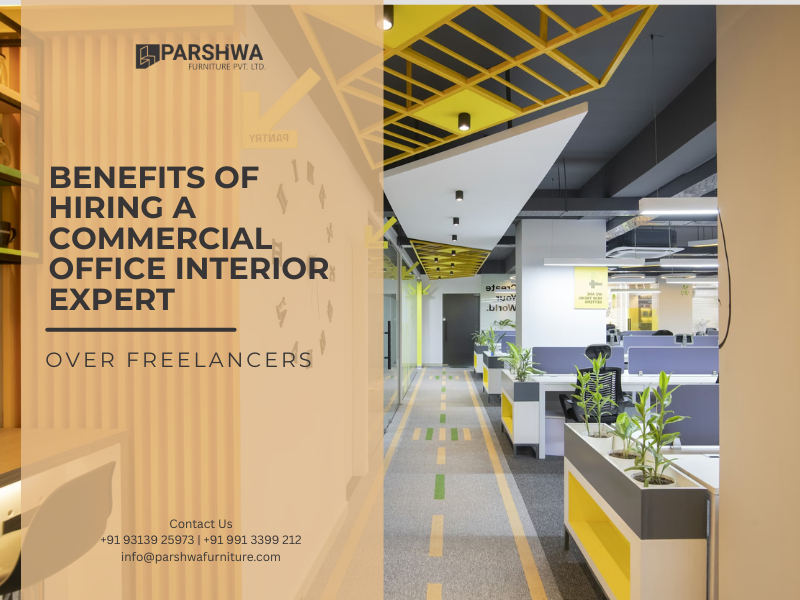
Benefits of Hiring a Commercial Office Interior Expert Over Freelancers
Choosing who designs your office isn't a simple vendor decision. It shapes how your team works every day, what clients think the moment they walk through the door, and whether the space still makes sense three years from now when your headcount has doubled.
Most businesses reach that crossroads with two obvious paths: bring in a freelancer, or engage a professional commercial office interior designer. On paper, the freelancer route looks appealing - lower upfront quotes, flexible scope, quick availability. But businesses that have walked both paths tend to tell a different story once they're actually sitting in the finished space.
Here's what that difference actually looks like in practice.
The Accountability Gap Nobody Talks About
Both freelancers and commercial interior firms produce design work. The gap opens up the moment execution begins.
A freelancer's scope is typically contained - space planning, concept development, material suggestions. What happens after that? You're coordinating with a civil contractor here, a furniture vendor there, an electrician who hasn't seen the drawings. Everyone is working from different reference points, and when something doesn't fit or a timeline slips, the question of who's responsible gets murky fast.
A professional commercial office interior designer operates differently. The project doesn't get handed off - it stays under one roof from planning through handover. That means a single point of contact, a unified timeline, and clear ownership at every stage.
For businesses pursuing office furniture turnkey projects in Ahmedabad, this matters enormously. Turnkey, by definition, means you receive a finished, functional workspace - not a half-built project with a list of vendors to chase.
What "Structured Process" Actually Saves You
Project delays in office fitouts rarely happen because someone wasn't trying hard enough. They happen because nobody owned the full picture.
Freelancers, working independently, are often dependent on third-party vendors for materials, fabrication, and site execution. A delay from one supplier creates a ripple that the freelancer may have no leverage to resolve. You end up managing the gap - which is exactly what you hired someone to avoid.
Established firms offering office furniture turnkey projects in India have resolved most of these dependencies in advance. They work with a vetted vendor network, maintain internal project management, and have handled enough projects to anticipate the problems that typically derail them. The result isn't perfection - it's predictability. And for a business planning an office move or expansion, predictability has real monetary value.
Functional Design vs. Photogenic Design
There's a version of office design that looks spectacular in photos and creates friction in everyday use. Corridors that feel elegant but slow people down. Meeting rooms positioned so that noise bleeds into focus areas. Workstations that look clean but lack adequate storage.
Experienced commercial office interior designers study how people actually move through and use a space. Which teams need to collaborate frequently? Where do impromptu conversations happen? What's the natural path from the entrance to the most-used conference room? These questions might seem granular, but the answers shape layout decisions that affect daily productivity.
For companies investing in corporate interior solutions, the goal isn't a beautiful brochure image - it's a workspace that makes people's jobs slightly easier every single day. That kind of outcome requires observation and experience, not just design talent.
Materials That Hold Up vs. Materials That Look Good Now
Walk into an office fitted out eighteen months ago by someone sourcing materials from whatever was available at the time, and you'll often notice it. Workstation edges that have chipped. Chair upholstery that's worn unevenly. Laminate finishes that have started to peel at the corners.
Commercial interior professionals specify materials to commercial-grade standards. They know which products hold up under the kind of use a busy office generates - and they have supplier relationships that make those materials accessible at reasonable cost.
Freelancers are typically drawing from a smaller, more consumer-oriented pool of vendors. The materials may look identical on day one. By month eighteen, the difference is visible.
In office furniture turnkey projects in Ahmedabad, where businesses expect their investment to perform well for several years, material selection isn't an aesthetic decision - it's an operational one.
The True Cost of the "Cheaper" Option
The lower quote from a freelancer reflects a smaller scope. What it doesn't reflect is the coordination burden that falls back on you, the rework costs when something needs to be changed mid-project, or the premium you pay for last-minute vendor decisions.
Professional firms approach project budgeting before they place a single order. Scope, materials, labor, and contingencies are mapped together. That upfront planning doesn't eliminate all surprises, but it prevents the kind of cascading cost overruns that happen when decisions are made reactively.
Office furniture turnkey projects consolidate procurement and execution under a single commercial relationship. That consolidation usually produces more predictable spend than a freelancer arrangement where components are sourced piecemeal from different vendors at different pricing tiers.
Compliance Isn't Optional - and It Requires Expertise
An office interior isn't just furniture and paint. It involves electrical layouts, fire egress planning, ventilation requirements, and structural load considerations. These aren't bureaucratic checkboxes - they're the difference between a space that gets an occupancy certificate and one that doesn't, or between a safe environment and a liability.
Freelancers with primarily aesthetic backgrounds may have limited exposure to technical compliance requirements, particularly in commercial-scale projects.
Firms specializing in corporate interior solutions integrate compliance into their process from the design stage. Electrical routing, fire safety provisions, and ventilation are planned alongside the aesthetic decisions rather than retrofitted around them. That approach prevents the expensive surprises that surface during inspections.
Timelines Have Business Consequences
Every week an office fitout runs long is a week your team is working in a suboptimal environment, or a week a new location isn't generating revenue. Timeline slippage isn't just inconvenient - it has a measurable cost.
Professional commercial interior firms manage timelines through structured project coordination. Progress is tracked, dependencies are identified early, and when issues surface, there's a team with the relationships and authority to resolve them quickly.
Independent freelancers, managing multiple clients simultaneously and dependent on external contractors, often lack the leverage to accelerate when a project falls behind.
For businesses choosing office furniture turnkey projects in India, delivery on schedule is a business requirement, not a preference.
Your Office Communicates Your Brand Before Anyone Speaks
A client arriving at your office forms an impression before they shake anyone's hand. An employee walking in on their first day forms a judgment about the company they've just joined. These impressions are shaped by the space - its quality, its coherence, whether it feels considered or accidental.
Professional commercial interior designers approach this deliberately. They learn what a company stands for, how it wants to be perceived, and what its culture actually feels like to work inside. That understanding informs decisions ranging from material selection to spatial layout to how light moves through the space.
A freelancer may deliver a space that looks polished. Whether it feels like your company is a harder outcome to engineer, and it requires the kind of deep engagement that most freelance arrangements don't prioritize.
For companies building serious corporate interior solutions, the workspace should reinforce the brand, not just house it.
Designing for the Business You're Becoming
Many office fitouts are planned around current headcount and immediately obvious needs. Within two or three years, the team has grown, workflows have changed, and the space that felt perfectly sized now feels constrained.
Commercial interior experts plan for this. Modular furniture systems that can be reconfigured, open zones that can be divided when needed, infrastructure that supports future technology requirements - these aren't expensive additions, they're thoughtful decisions that preserve the value of your investment over time.
This forward-looking approach matters especially in office furniture turnkey projects in Ahmedabad, where many businesses are in active growth phases. A space designed only for today creates a fitout cost again in three years. One designed with growth in mind doesn't.
Technology Infrastructure: Getting It Right the First Time
Modern offices run on technology. Video conferencing, collaborative displays, sound masking, smart access control - these systems need to be integrated into the physical space, not added to it as an afterthought.
That means conduit routing needs to be planned before walls go up, not after. It means meeting room acoustics need to account for microphone placement. It means charging infrastructure needs to match how people actually work, not how they worked five years ago.
Commercial interior specialists build technology requirements into the design from the start. The result is a space where the tech works with the architecture rather than fighting against it. Freelancers working primarily on the aesthetic dimension of a project may not have the expertise or vendor relationships to deliver this integration.
The Relationship Doesn't End at Handover
An office is a living environment. Workstations get reconfigured. New hires need additional seating. A department reorganizes and needs its layout adjusted. Materials wear and need to be matched and replaced.
When you work with a professional commercial interior firm, that ongoing relationship is part of what you're paying for. The firm knows your space, your standards, and your preferences. Modifications get handled efficiently because the context already exists.
With a freelancer, the engagement typically ends when the design phase concludes. What happens next - maintenance, adjustments, additions - reverts to you.
For businesses treating their workspace as a long-term asset rather than a one-time project, having a reliable partner for the ongoing lifecycle of the space is a meaningful advantage.
Why Turnkey Solutions Are Gaining Ground in Ahmedabad
Ahmedabad's commercial landscape is evolving quickly. Businesses expanding into new offices or upgrading existing ones are increasingly prioritizing efficiency and delivery certainty over cost minimization.
The growth of office furniture turnkey projects in Ahmedabad reflects a straightforward realization: coordinating multiple freelancers and vendors takes management bandwidth that most businesses don't have to spare. A single firm that handles the complete scope - design, procurement, fabrication, installation, and handover - removes that burden.
The result isn't just a finished office. It's a finished office delivered on time, within scope, and without the coordination overhead that fragmented arrangements require.
The Practical Summary
Working with a professional commercial office interior designer rather than a freelancer isn't about prestige - it's about outcomes. It's about getting a space that functions as well as it looks, delivered when you need it, built to last, and designed with an understanding of what your business actually needs.
For companies planning corporate interior solutions or pursuing office furniture turnkey projects in India, the expertise, accountability, and end-to-end ownership that a professional firm brings isn't a luxury addition to the project - it's what makes the project succeed.
The right workspace doesn't just house your team. It works for them.